Budget Phone vs High-End Phone: A Practical Guide to Getting Value for Your Money in 2026
Walk into any phone store or scroll through an online marketplace, and you will see two very different worlds. On one side, there are phones priced under ₹20,000 that promise to do everything. On the other, there are phones costing over ₹1,00,000 that promise to do everything better. The question is simple: is the extra money actually worth it?
This guide will break down the real differences between budget and high-end phones in 2026, using the latest models from Xiaomi, Motorola, Samsung, and others. We will look at performance, cameras, battery life, software support, and the one factor that matters most: value. By the end, you will know exactly which type of phone makes sense for your needs.
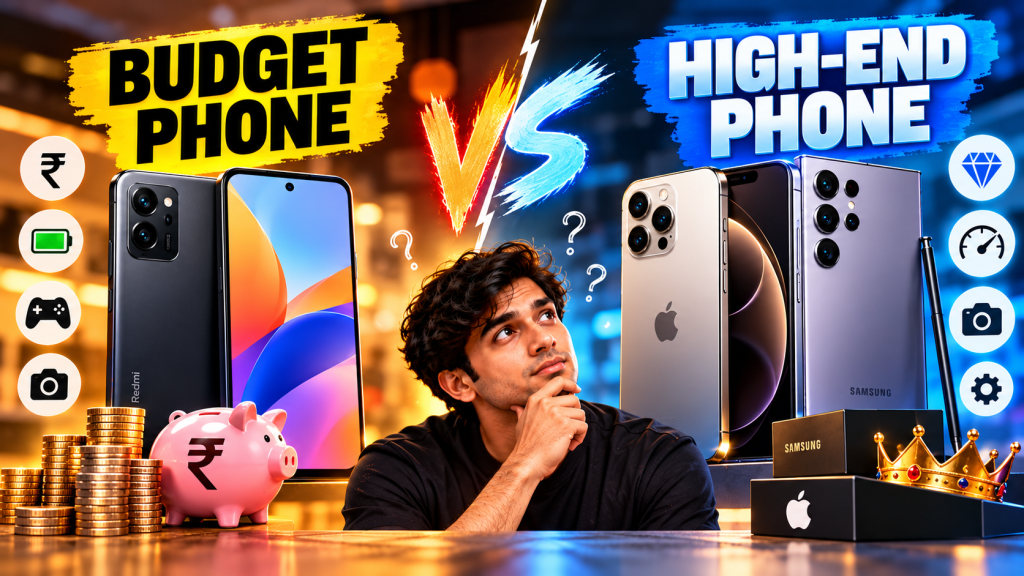
The 2026 Market Context: Why Budget Phones Are Getting More Expensive
Before we compare, you need to understand something important about the current market. In 2026, budget phones are not the bargains they used to be. Global memory and RAM prices have surged, driven largely by the AI boom, and this has hit budget phones the hardest. Memory can represent 15–20% of the total cost of a mid-range device, compared to just 10–15% for a flagship. This means every price increase hurts the budget segment more.
The result? The price gap between mid-range and flagship phones is narrowing. Premium smartphones (wholesale price of $600 and above) grabbed a record 29% of global sales in the first half of 2026, up from 25% a year earlier. Consumers are realising that stretching their budget a little further might actually get them a better deal.
Nothing CEO Carl Pei summed it up well: “If you’ve been waiting to upgrade a device, the best time was yesterday. The next best time is now”.
The Core Differences: What Separates a ₹15,000 Phone from a ₹1,50,000 Phone
1. The Processor: The Engine Under the Hood
The single biggest difference between a budget phone and a flagship is the System on a Chip (SoC). This chip contains the CPU, GPU, and memory controller, and it determines how fast your phone feels.
Budget phones typically use entry-level chips like the Snapdragon 4 Gen 2 or MediaTek Dimensity 6300. These are fine for calls, messaging, social media, and light gaming. The Redmi 14C 5G, for example, runs on the Snapdragon 4 Gen 2 and handles daily tasks well.
Flagship phones use top-tier chips like the Snapdragon 8 Elite Gen 5 or Apple’s A20 Pro. The Xiaomi 17 series is powered by the Snapdragon 8 Elite Gen 5, built on a 3nm process. The Motorola Razr Fold also uses the Snapdragon 8 Gen 5.
What this means in practice: If you mainly text, call, browse, and use social media, you will not notice a huge difference. The gap becomes obvious when you run demanding games like Genshin Impact, edit 4K video, or multitask heavily.
2. The Camera: More Than Just Megapixels
Camera hardware is where flagships justify their price most clearly.
Budget phones usually have a single usable camera (often 50MP) and a secondary sensor that is mostly decorative. The Samsung Galaxy A06 5G has a 50MP + 2MP dual setup. It takes decent photos in good light but struggles in low light.
Flagship phones have multiple high-quality sensors. The Motorola Razr Fold has three 50MP cameras: a main sensor, a periscope telephoto with 3x optical zoom, and an ultrawide lens. The Xiaomi 17 Ultra has a 1-inch main sensor and a 200MP periscope telephoto camera.
What this means in practice: For casual photos in daylight, a budget phone is fine. For low-light photography, zoom, portrait shots, and video recording, the flagship is in a completely different league.
3. Battery and Charging: Bigger Isn’t Always Better
Budget phones often have large batteries. The Redmi 14C 5G has a 5,160mAh battery with 18W charging. The Samsung Galaxy A06 5G has a 5,000mAh battery with 25W charging.
Flagship phones may have slightly smaller batteries but charge much faster. The Xiaomi 17 has a 6,330mAh battery with 100W wired and 50W wireless charging. The Motorola Razr Fold has a 6,000mAh battery with 80W wired and 50W wireless charging.
What this means in practice: Budget phones last a long time on a single charge but take hours to recharge. Flagships charge in minutes, which is a genuine quality-of-life improvement if you are always on the go.
4. Display: The Window to Your Phone
Budget phones typically have LCD displays with 90Hz or 120Hz refresh rates. The Samsung Galaxy A06 5G has a 6.74-inch LCD with 90Hz. These are perfectly usable, but colours and brightness are not as impressive.
Flagship phones have OLED or LTPO AMOLED displays with 120Hz or even 165Hz refresh rates and peak brightness over 3,000 nits. The Xiaomi 17 has a 6.3-inch LTPO AMOLED display with 3,500 nits of peak brightness. The Motorola Razr Fold’s main display is a 6.92-inch OLED with a 165Hz refresh rate.
What this means in practice: A flagship display is noticeably brighter, more colourful, and smoother. If you watch a lot of video or use your phone outdoors, this matters.
5. Build Quality and Durability
Budget phones are usually made of plastic. They may have some water resistance (like IP52 on the Redmi 14C 5G).
Flagship phones use premium materials like aluminium and glass, with IP68 certification for dust and water resistance. The Xiaomi 17 series has an aluminium frame and IP68 certification. The Motorola Razr Fold is the first phone to use Corning Gorilla Glass Ceramic 3, with a 75% improvement in drop performance.
What this means in practice: Flagships feel more premium and survive accidents better. Budget phones are more fragile.
6. Software Support: The Long Game
Budget phones typically receive 2 to 3 years of Android updates and 3 to 4 years of security patches.
Flagship phones now offer 6 to 7 years of updates. The Motorola Razr Fold promises up to seven Android OS upgrades and seven years of security updates. Samsung and Google offer similar commitments.
What this means in practice: If you keep your phone for 5+ years, a flagship is the only option that will stay secure and up-to-date.
Real-World Comparisons: Budget vs Flagship in 2026
Let us compare some actual models available in India right now.
Xiaomi 17 Pro vs Redmi 14C 5G
The Xiaomi 17 Pro costs around ₹62,990. The Redmi 14C 5G costs under ₹15,000.
What you get for the extra ₹48,000:
-
Snapdragon 8 Elite Gen 5 vs Snapdragon 4 Gen 2
-
6.3-inch LTPO AMOLED (3,500 nits, 120Hz) vs 6.88-inch LCD (120Hz)
-
Triple 50MP cameras vs 50MP + 2MP
-
6,330mAh battery with 100W charging vs 5,160mAh with 18W charging
-
12GB RAM and 256GB storage vs 6GB RAM and 128GB storage
-
7 years of updates vs 2–3 years
Motorola Razr Fold vs Samsung Galaxy A06 5G
The Motorola Razr Fold costs ₹1,49,999 in India. The Samsung Galaxy A06 5G costs under ₹15,000.
What you get for the extra ₹1,35,000:
-
A foldable 8.1-inch inner display and 6.6-inch outer display vs a standard 6.74-inch LCD
-
Snapdragon 8 Gen 5 vs MediaTek Dimensity 6300
-
Triple 50MP cameras with 3x optical zoom vs 50MP + 2MP
-
6,000mAh battery with 80W charging vs 5,000mAh with 25W charging
-
16GB RAM and up to 1TB storage vs 4–6GB RAM and 64–128GB storage
-
Bose-tuned stereo speakers, stylus support, and 7 years of updates
The Value Question: When Does a Flagship Make Sense?
Here is the honest truth: for most people, a budget phone is enough. If you use your phone for calls, WhatsApp, Instagram, YouTube, and casual photos, a ₹15,000 phone will do everything you need. The Galaxy A06 5G, for example, offers a reliable software experience and a large display at a fraction of the cost of a flagship.
But there are situations where a flagship is genuinely worth the money.
Buy a flagship if:
-
You are a heavy gamer who plays demanding titles like Genshin Impact or Call of Duty Mobile.
-
You are serious about photography and want the best low-light performance, zoom, and video quality.
-
You plan to keep your phone for 5+ years and want the longest possible software support.
-
You use your phone for professional work like video editing or content creation.
-
You want the best display, the fastest charging, and the most premium build quality.
Buy a budget phone if:
-
You use your phone for basic tasks like calls, messaging, and social media.
-
You upgrade your phone every 2–3 years.
-
You want the best value for money and do not need the latest features.
-
You are buying a phone for a family member who does not need a flagship.
The 2026 Twist: Why Flagships Are Becoming Better Value
Something unusual is happening in 2026. Flagships are starting to look like better value than mid-range phones. Why? Because mid-range prices are rising faster than flagship prices.
When a mid-range phone pushes toward ₹40,000 or ₹50,000, paying a little extra for a discounted or older flagship makes more sense. A last-generation flagship like the Samsung Galaxy S25 or Google Pixel 10 offers stronger processors, better cameras, and longer software support than a new mid-range phone at the same price.
This is why the “previous generation rule” is more relevant than ever: buy last year’s flagship instead of this year’s mid-ranger. You get 90–95% of the experience for 60–70% of the price.
A Decision Framework: What Should You Actually Buy?
Here is a simple framework based on your budget and needs.
| Your Budget | Best Choice | Why |
|---|---|---|
| Under ₹15,000 | Redmi 14C 5G, Samsung Galaxy A06 5G, Vivo Y19s 5G | Good enough for daily tasks, large batteries, 5G connectivity |
| ₹15,000 – ₹25,000 | Moto G37 Power, POCO M8x 5G, Vivo T5 Lite 5G | Better displays, faster charging, more storage |
| ₹25,000 – ₹40,000 | Nothing Phone (4a), Poco X8 Pro, Moto Edge 70 Pro | Near-flagship performance without the flagship price |
| ₹40,000 – ₹70,000 | Xiaomi 17 Pro, OnePlus 15R, older flagships | Flagship performance, excellent cameras, long software support |
| Above ₹70,000 | Xiaomi 17 Ultra, Samsung Galaxy S26 Ultra, Motorola Razr Fold | The best of everything: cameras, displays, performance, and durability |
The Golden Rules of Phone Buying
Rule 1: Define your actual needs first. Do not buy a flagship if you only use your phone for WhatsApp and YouTube. Do not buy a budget phone if you are a serious gamer.
Rule 2: Consider last year’s flagship. A discounted Galaxy S25 or Pixel 10 is often a better deal than a new mid-range phone at the same price.
Rule 3: Check the software support. If you plan to keep your phone for 4+ years, buy a phone with at least 5 years of updates.
Rule 4: Wait for sales. Festive sales like Amazon Great Indian Festival and Flipkart Big Billion Days offer significant discounts on both budget and flagship phones.
Rule 5: Do not buy on launch day. Wait at least 2–3 months for prices to stabilise and reviews to come out.
Final Words: The Smart Choice
The phone industry wants you to believe that you need the latest flagship. The truth is simpler: most people do not. A budget phone in 2026 can handle 90% of what most people do every day.
But if you are a power user who values camera quality, gaming performance, or long-term software support, a flagship is a worthwhile investment. And with mid-range prices rising, a discounted flagship might actually be the smartest purchase you can make.
The best phone is not the most expensive one. It is the one that fits your needs, your habits, and your budget. Buy that phone, and you will be happy with it for years.